Here's a delightful article in the San Francisco Chronicle about a Nobel laureate physicist from UC-Berkeley who was willing to go on the TV show "Are you smarter than a Fifth Grader," where he won a million dollars competing against fifth graders.
As my students are taking their VITA certification exams this week, I got the idea that maybe House Ways and Means Chairman Rangel and Treasury Secretary Geithner should be asked to appear on a TV show called "Are you smarter than a VITA volunteer?"
Although error rates in nationwide samples of all types of preparers (including VITA) are unacceptably high, I know some VITA volunteers who could certainly give them a run for the money on their knowledge of basic tax law that applies to ordinary Americans.
I rarely watch TV, but I think this show would make compelling viewing.
I will say this: I will be holding my VITA students to much higher standards than Chairman Rangel and Secretary Geithner have met.
Showing posts with label National Tax Bee. Show all posts
Showing posts with label National Tax Bee. Show all posts
Tuesday, January 5, 2010

Saturday, October 3, 2009
Why we need a National Tax Bee
Word in italics below come from Lewis and Clark Professor Jack Bogdansky's blog post in April 2005.
If Congress had actually followed Prof. Bogdansky's advice, Treasury Secretary Timothy Geithner would have been home free with a TurboTax defense.
We need a tax code PEOPLE can understand. A National Tax Bee would be a great way to highlight this need.
Congress is getting on the case of banks for writing mortgage contracts and credit card agreements with "gotcha!" provisions that hapless ordinary Americans can't understand. They have been getting on the case of health insurance companies for writing applications with "gotcha!" questions that ordinary Americans can't understand. Those gotcha! provisions come back to bite them later on, when the banks raise rates and insurance companies cancel coverage.
Congress needs to get on its OWN case, because the tax code it writes is even more complex, convoluted, and hard to understand than any mortgage contract, credit card contract, or insurance application that I've ever seen. Try reading it for yourself and you'll soon see what I mean. It is full of doublespeak. It has provisions that may look readable and clear enough, but then if you keep on reading, it turns out that later on the code says something completely different that completely supersedes and contradicts what you thought you understood earlier.
The American public, who once took a certain amount of gritty pride in figuring out their own income taxes, has given up trying to understand it. If the Treasury Department Secretary and the Chairman of the House Ways and Means Committee can't understand tax law, what hope do the rest of us have?
A National Tax Bee would focus public attention on the fact that our income tax code is an important part of our social fabric, our social contract.
It OUGHT to be something that all of us can fundamentally understand.
Virtually every major decision we make in our life can affect our income tax liability, often in profound ways:
birth of children
marriage
divorce
work
education
buying a home
selling a home
financing a home
saving and investing for the future
moving to take a new job in another location
starting a business
growing that business
selling the business
retirement
dying
Understanding an income tax with so many important ramifications should NOT be the province of an elite few computer programmers!
At our VITA site, our student preparers take the time to walk our clients line by line through their returns so that they understand the documents we asking them to sign.
Many clients gratefully tell us that no other tax preparer has ever bothered to do that before.
This is so very sad and very wrong!
The income tax law requires that taxpayers sign their returns UNDER PENALTY OF PERJURY. It is understandable but wrong that preparers do not take the time to explain the documents they are asking taxpayers to sign. The taxpayers lead busy lives and most are eager to find out the amount of their refund. And there is so much boilerplate gobble-di-gook on their tax returns, that it's understandable that many taxpayers think it's hopeless to understand their tax returns, so they don't even try to do so.
But what they don't understand at the time they sign the return CAN and DOES come back to bite them later. (Check out the sad story of a taxpayer in the video in my earlier post. She authorized her tax preparer to efile her return but didn't even bother to look at the tax return until two years later, when she got an audit notice from the IRS. Only then did she pull out her copy of the return and discover that the preparer had completely fabricated deductions. As she put it: "Uniform expenses? I'm a travel agent. I wear what I want to work." These are the kinds of questions taxpayers need to ask their preparers BEFORE they authorize them to efile.)
Taxpayers need to be able to "kick the tires" before they sign their tax returns. They need to be able to ask their tax preparers (or their tax software), "Hmmm, where on here did you put that information I told you about the money I took out of my IRA last year?" or "Why are you reporting deductions for uniform expenses? I don't wear a uniform at work!"
We are talking about a LOT of money here.
Over the past six decades, about 3 out of every 10 dollars in Americans' income has gone to taxes of one form or another: income, payroll, excise, property, sales. Nobody likes taxes, but many people believe the income tax can and should be the fairest tax. Many Americans, including some low-income Americans, face MARGINAL income tax rates of 40% or more, when all is said and done.
And the hard economic reality is that however high taxes may currently be, they are NOT enough to sustain the commitments the country has already made to the future. Tax rates need to go up. The current rates are possible only because the entire world is still willing to lend our government vast amounts of money at phenomenally reasonable interest rates. This situation will NOT last.
With so much at stake, Americans deserve to understand their income tax system MUCH better than they do now. If Treasury Secretary Geithner, House Ways and Means Chair Rangel, and a host of presidential appointees can't understand their income tax obligations, what hopes do ordinary Americans have?
But Americans are busy with their day to day lives. It's hard to get their attention on important long-term problems.
A National Tax Bee could be a start in educating Americans about our current tax system AND getting them to demand a tax system all Americans can truly understand and support.
Congress knows that as long as the people at Intuit who are writing the TurboTax program can figure out the tax laws, Congress doesn't have to write a tax code that anyone else can fully understand.
...
A few years back, a bright student and I were conversing about this very topic when she made an intriguing suggestion. Instead of Congress writing tax laws in a legal form of English that mere-mortal accountants and attorneys can understand, and then having Intuit put it into computer code, why not have Congress simply pass the computer code itself? In other words, rather than say, "Your tax is your income minus these deductions, multiplied by these tables -- now go buy a private computer program to try to get it right," Congress could simply say, "Your tax is what this computer language says you owe after plugging in the income and expense information that it calls for."
If Congress had actually followed Prof. Bogdansky's advice, Treasury Secretary Timothy Geithner would have been home free with a TurboTax defense.
We need a tax code PEOPLE can understand. A National Tax Bee would be a great way to highlight this need.
Congress is getting on the case of banks for writing mortgage contracts and credit card agreements with "gotcha!" provisions that hapless ordinary Americans can't understand. They have been getting on the case of health insurance companies for writing applications with "gotcha!" questions that ordinary Americans can't understand. Those gotcha! provisions come back to bite them later on, when the banks raise rates and insurance companies cancel coverage.
Congress needs to get on its OWN case, because the tax code it writes is even more complex, convoluted, and hard to understand than any mortgage contract, credit card contract, or insurance application that I've ever seen. Try reading it for yourself and you'll soon see what I mean. It is full of doublespeak. It has provisions that may look readable and clear enough, but then if you keep on reading, it turns out that later on the code says something completely different that completely supersedes and contradicts what you thought you understood earlier.
The American public, who once took a certain amount of gritty pride in figuring out their own income taxes, has given up trying to understand it. If the Treasury Department Secretary and the Chairman of the House Ways and Means Committee can't understand tax law, what hope do the rest of us have?
A National Tax Bee would focus public attention on the fact that our income tax code is an important part of our social fabric, our social contract.
It OUGHT to be something that all of us can fundamentally understand.
Virtually every major decision we make in our life can affect our income tax liability, often in profound ways:
birth of children
marriage
divorce
work
education
buying a home
selling a home
financing a home
saving and investing for the future
moving to take a new job in another location
starting a business
growing that business
selling the business
retirement
dying
Understanding an income tax with so many important ramifications should NOT be the province of an elite few computer programmers!
At our VITA site, our student preparers take the time to walk our clients line by line through their returns so that they understand the documents we asking them to sign.
Many clients gratefully tell us that no other tax preparer has ever bothered to do that before.
This is so very sad and very wrong!
The income tax law requires that taxpayers sign their returns UNDER PENALTY OF PERJURY. It is understandable but wrong that preparers do not take the time to explain the documents they are asking taxpayers to sign. The taxpayers lead busy lives and most are eager to find out the amount of their refund. And there is so much boilerplate gobble-di-gook on their tax returns, that it's understandable that many taxpayers think it's hopeless to understand their tax returns, so they don't even try to do so.
But what they don't understand at the time they sign the return CAN and DOES come back to bite them later. (Check out the sad story of a taxpayer in the video in my earlier post. She authorized her tax preparer to efile her return but didn't even bother to look at the tax return until two years later, when she got an audit notice from the IRS. Only then did she pull out her copy of the return and discover that the preparer had completely fabricated deductions. As she put it: "Uniform expenses? I'm a travel agent. I wear what I want to work." These are the kinds of questions taxpayers need to ask their preparers BEFORE they authorize them to efile.)
Taxpayers need to be able to "kick the tires" before they sign their tax returns. They need to be able to ask their tax preparers (or their tax software), "Hmmm, where on here did you put that information I told you about the money I took out of my IRA last year?" or "Why are you reporting deductions for uniform expenses? I don't wear a uniform at work!"
We are talking about a LOT of money here.
Over the past six decades, about 3 out of every 10 dollars in Americans' income has gone to taxes of one form or another: income, payroll, excise, property, sales. Nobody likes taxes, but many people believe the income tax can and should be the fairest tax. Many Americans, including some low-income Americans, face MARGINAL income tax rates of 40% or more, when all is said and done.
And the hard economic reality is that however high taxes may currently be, they are NOT enough to sustain the commitments the country has already made to the future. Tax rates need to go up. The current rates are possible only because the entire world is still willing to lend our government vast amounts of money at phenomenally reasonable interest rates. This situation will NOT last.
With so much at stake, Americans deserve to understand their income tax system MUCH better than they do now. If Treasury Secretary Geithner, House Ways and Means Chair Rangel, and a host of presidential appointees can't understand their income tax obligations, what hopes do ordinary Americans have?
But Americans are busy with their day to day lives. It's hard to get their attention on important long-term problems.
A National Tax Bee could be a start in educating Americans about our current tax system AND getting them to demand a tax system all Americans can truly understand and support.
Friday, October 2, 2009
National Tax Bee: further thoughts
While the tax gap is a serious problem, and the complexity of US tax law places huge burdens on all Americans, Americans have a well-deserved reputation as some of the most law-abiding taxpayers in the world. Surveys show that most Americans actually want to comply with the tax law, and many take enormous time, trouble, and expense to do so.
Last year, an exchange student told me that her parents back home in another country do not need to file tax returns, because, as she put it, "The government just knows everything about you, and they just take the money away before you ever get it."
In some countries, cheating the government out of taxes is actually something of a national sport.
During World War II, most Americans took great pride in complying with tax law, which was relatively new for them. Before World War II, only a very small percentage of Americans paid income taxes. As the saying goes, during World War II, the income tax went from a "class tax" (on the wealth) to a "mass tax" (on almost everybody.)
Perhaps a National Tax Bee could celebrate and promote the fact that American taxpayers are actually among the most law-abiding in the world.
It's also important to promote the role of the many competent and conscientious tax preparers who help those taxpayers deal with the compliance burdens our tax law imposes.
We hear about the scofflaws and the incompetent, but it's really important to recognize the many honest taxpayers and the professionals who are doing their best to help them comply with our country's tax laws.
Last year, an exchange student told me that her parents back home in another country do not need to file tax returns, because, as she put it, "The government just knows everything about you, and they just take the money away before you ever get it."
In some countries, cheating the government out of taxes is actually something of a national sport.
During World War II, most Americans took great pride in complying with tax law, which was relatively new for them. Before World War II, only a very small percentage of Americans paid income taxes. As the saying goes, during World War II, the income tax went from a "class tax" (on the wealth) to a "mass tax" (on almost everybody.)
Perhaps a National Tax Bee could celebrate and promote the fact that American taxpayers are actually among the most law-abiding in the world.
It's also important to promote the role of the many competent and conscientious tax preparers who help those taxpayers deal with the compliance burdens our tax law imposes.
We hear about the scofflaws and the incompetent, but it's really important to recognize the many honest taxpayers and the professionals who are doing their best to help them comply with our country's tax laws.
ESPN take note: a National Tax Bee?
The popular stereotype of a tax professional paints them as bland and boring, robotic and devoid of personality. Reading tax pro blogs has certainly convinced me otherwise.
A quintessential example of a colorful (sometimes to the point of flamboyance!) character is Robert D Flach, who writes the Wandering Tax Pro blog. Robert's blog gives fascinating glimpses into his professional life as an unenrolled tax preparer who has been preparing tax returns in New Jersey since the early 1970s. Based on what I can discern from his blog posts, he seems exceptionally conscientious, scrupulously careful, and well-versed in tax law. It's also clear that he takes pains to stay up to date with the ever-changing tax law, as his latest post includes notes he took during his attendance at a recent continuing ed seminar for tax preparers. (As an unenrolled preparer, no law compels him to take this training, but it's clear that he embraces such opportunities whole-heartedly--he's clearly no "seat-warmer." Based on his blog posts, I would guess that his class participation contributes a lot to the liveliness of the sessions and helps keep the other preparers awake.)
His use of the occasional expletive in his blog is a bit jarring--his language sometimes sounds more like that of a sailor than a tax professional, but otherwise, his blog posts suggest that he serves his clients very well, minimizing their tax burdens while staying completely within the law.
He clearly takes pride in the tax returns he prepares for his clients, regarding them as works of art. He writes them out in meticulous longhand, since he eschews the use of tax software. I suspect he may be in a class by himself in that respect--I've never met or heard of any other tax pros who don't use software.
Although he refuses to use software, he apparently does like to watch TV (and complains a lot about reality TV shows.) I watch very little TV myself, aside from my two annual rituals (the National Spelling Bee in late spring and the Times Square ball at midnight on New Year's Eve), but recently I did catch a fascinating episode of a show called "Are you smarter than a fifth grader?" in which a Nobel Laureate physicist wound up winning a million dollars and the right to say "I am smarter than a fifth grader."
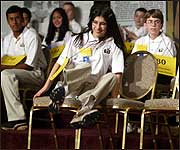
All of this has given me a great idea for highlighting the bizarreness of the tax code: ESPN should televise a National Tax Bee, just as they televise the National Spelling Bee. Robert would make a great contestant on such a show (though they might have to bleep out the occasional expletive.)
The Bee could present little minitax scenarios and the contestants would take turns figuring out the answers. Just as the National Spelling Bee doesn't allow spellers to use computerized spell-check, the National Tax Bee wouldn't allow preparers to use software. The rules should allow them to use the tax forms, tax instructions, Pub 17, and copies of the tax code for reference.
Just as the National Spelling Bee doesn't ask contestants to spell out whole essays, the questions would be relatively short and self-contained focusing on particular aspects of tax situations (such as, "Who gets to claim this kid?" or "What is the filing status?" or "Is this allowable as an itemized deduction?" etc.)
There are some details to work out. The tax code and regulations are much more convoluted and less readable than the Webster's Third New International Dictionary, and they also have an order of magnitude more pages than the dictionary. So the judging panel would have to be pretty resourceful in dealing with contestant challenges to the official "correct" answers. I can imagine some ways to handle this. Contestants who want to submit challenges could submit them in writing, to be referred to a panel of tax law professor judges in an isolation booth, so that they would not know the identity of the contestants whose challenges they are evaluating.
Just like the National Spelling Bee, the early round questions would start out with reasonably commonplace but challenging tax situations and then they'd get more and more bizarre and obscure with succeeding rounds.
Here's a contestant lineup that would make for an interesting show:
Robert D Flach, Tax Girl Kelly Erb, The Tax Lawyer Peter Pappas
HR Block, Jackson Hewitt, and Liberty Tax could be invited to send their top tax preparers
VITA and AARP could be invited to send their top tax preparers
The IRS could enter a few expert employees from different departments (TAC, SPEC, audit, NTA all come to mind as possibilities)
The American Bar Association and CPA professional societies could be invited to send their top tax lawyers and CPAs
Then we could have some celebrity contestants: There are many interesting possibilities in Congress--I'd put my money on Barney Frank over Charles Rangel, any day. Larry Summers vs. Tim Geithner would be an interesting match up--that would be a lot closer, but my bet would go on Larry. Maybe the CEOs of the big chains also.
Who else would you suggest for this show? Feel free to leave your suggestions in the comments.
And what about the judging panel? The tax law professors would be the clear choices for that--and some of them would be at least as colorful as the contestants.
As for color and play-by-play commentary, I'd love to see National Taxpayer Advocate Nina Olson in the anchor role, along with Alice Rivlin and Economist Mom as well. Nina could talk about the hardships faced by American taxpayers in trying to comply with the code, while the other two commentators could talk about the cost of all those exotic loopholes for the favored few in terms of the burden they inflict on the rest of us. It would be a great chance to talk about how tax reform could improve our economy.
It could be a great way to educate the American public about tax law. Imagine everything the public could learn from watching a show like this:
1) How to comply with basic tax law (from the early round questions)
2) Some good questions to ask your preparer to see if he knows his own stuff (from the middle round questions)
3) The ridiculous complexity of tax law and the crying need for tax reform and simplification. (from the final round questions)
There could also be student editions of the show, perhaps with different divisions: middle school, high school, college, professional schools.
ESPN, are you listening? (Hey, Noah Webster is in my family tree, and as the mother of two former National Spelling Bee contestants, I'd be happy to volunteer my services as a consultant in developing the show.)
This could be a huge opportunity for television to do some real good for a change.
A quintessential example of a colorful (sometimes to the point of flamboyance!) character is Robert D Flach, who writes the Wandering Tax Pro blog. Robert's blog gives fascinating glimpses into his professional life as an unenrolled tax preparer who has been preparing tax returns in New Jersey since the early 1970s. Based on what I can discern from his blog posts, he seems exceptionally conscientious, scrupulously careful, and well-versed in tax law. It's also clear that he takes pains to stay up to date with the ever-changing tax law, as his latest post includes notes he took during his attendance at a recent continuing ed seminar for tax preparers. (As an unenrolled preparer, no law compels him to take this training, but it's clear that he embraces such opportunities whole-heartedly--he's clearly no "seat-warmer." Based on his blog posts, I would guess that his class participation contributes a lot to the liveliness of the sessions and helps keep the other preparers awake.)
His use of the occasional expletive in his blog is a bit jarring--his language sometimes sounds more like that of a sailor than a tax professional, but otherwise, his blog posts suggest that he serves his clients very well, minimizing their tax burdens while staying completely within the law.
He clearly takes pride in the tax returns he prepares for his clients, regarding them as works of art. He writes them out in meticulous longhand, since he eschews the use of tax software. I suspect he may be in a class by himself in that respect--I've never met or heard of any other tax pros who don't use software.
Although he refuses to use software, he apparently does like to watch TV (and complains a lot about reality TV shows.) I watch very little TV myself, aside from my two annual rituals (the National Spelling Bee in late spring and the Times Square ball at midnight on New Year's Eve), but recently I did catch a fascinating episode of a show called "Are you smarter than a fifth grader?" in which a Nobel Laureate physicist wound up winning a million dollars and the right to say "I am smarter than a fifth grader."
All of this has given me a great idea for highlighting the bizarreness of the tax code: ESPN should televise a National Tax Bee, just as they televise the National Spelling Bee. Robert would make a great contestant on such a show (though they might have to bleep out the occasional expletive.)
The Bee could present little minitax scenarios and the contestants would take turns figuring out the answers. Just as the National Spelling Bee doesn't allow spellers to use computerized spell-check, the National Tax Bee wouldn't allow preparers to use software. The rules should allow them to use the tax forms, tax instructions, Pub 17, and copies of the tax code for reference.
Just as the National Spelling Bee doesn't ask contestants to spell out whole essays, the questions would be relatively short and self-contained focusing on particular aspects of tax situations (such as, "Who gets to claim this kid?" or "What is the filing status?" or "Is this allowable as an itemized deduction?" etc.)
There are some details to work out. The tax code and regulations are much more convoluted and less readable than the Webster's Third New International Dictionary, and they also have an order of magnitude more pages than the dictionary. So the judging panel would have to be pretty resourceful in dealing with contestant challenges to the official "correct" answers. I can imagine some ways to handle this. Contestants who want to submit challenges could submit them in writing, to be referred to a panel of tax law professor judges in an isolation booth, so that they would not know the identity of the contestants whose challenges they are evaluating.
Just like the National Spelling Bee, the early round questions would start out with reasonably commonplace but challenging tax situations and then they'd get more and more bizarre and obscure with succeeding rounds.
Here's a contestant lineup that would make for an interesting show:
Robert D Flach, Tax Girl Kelly Erb, The Tax Lawyer Peter Pappas
HR Block, Jackson Hewitt, and Liberty Tax could be invited to send their top tax preparers
VITA and AARP could be invited to send their top tax preparers
The IRS could enter a few expert employees from different departments (TAC, SPEC, audit, NTA all come to mind as possibilities)
The American Bar Association and CPA professional societies could be invited to send their top tax lawyers and CPAs
Then we could have some celebrity contestants: There are many interesting possibilities in Congress--I'd put my money on Barney Frank over Charles Rangel, any day. Larry Summers vs. Tim Geithner would be an interesting match up--that would be a lot closer, but my bet would go on Larry. Maybe the CEOs of the big chains also.
Who else would you suggest for this show? Feel free to leave your suggestions in the comments.
And what about the judging panel? The tax law professors would be the clear choices for that--and some of them would be at least as colorful as the contestants.
As for color and play-by-play commentary, I'd love to see National Taxpayer Advocate Nina Olson in the anchor role, along with Alice Rivlin and Economist Mom as well. Nina could talk about the hardships faced by American taxpayers in trying to comply with the code, while the other two commentators could talk about the cost of all those exotic loopholes for the favored few in terms of the burden they inflict on the rest of us. It would be a great chance to talk about how tax reform could improve our economy.
It could be a great way to educate the American public about tax law. Imagine everything the public could learn from watching a show like this:
1) How to comply with basic tax law (from the early round questions)
2) Some good questions to ask your preparer to see if he knows his own stuff (from the middle round questions)
3) The ridiculous complexity of tax law and the crying need for tax reform and simplification. (from the final round questions)
There could also be student editions of the show, perhaps with different divisions: middle school, high school, college, professional schools.
ESPN, are you listening? (Hey, Noah Webster is in my family tree, and as the mother of two former National Spelling Bee contestants, I'd be happy to volunteer my services as a consultant in developing the show.)
This could be a huge opportunity for television to do some real good for a change.
Subscribe to:
Posts (Atom)