Showing posts with label tax commandments. Show all posts

Saturday, January 7, 2012

Eighth commandment: Thou shalt beware that not all dependents are created equal!


Updated Jan 2019

There are many different types of dependents.  Not all are equally valuable.


Qualifying Child dependent under age 17 who lived with the taxpayer is usually the best kind of dependent to have.  This type of dependent can qualify the taxpayer for the following tax benefits:

  • Child Tax Credit of $2,000 (of which up to $1,400 may be refundable)
  • Qualifying Child for REFUNDABLE Earned Income Credit 
  • Qualifying Person for HoH filing status
  • Daycare expenses may qualify for Child & Dependent Care credit (if under 13 or disabled)
  • Medical expenses will be deductible if taxpayer itemizes


Qualifying Child dependent over 17 but under 19 (or QC under 24 & ¨full-time¨ student or QC any age if disabled) who lived with the taxpayer is also a very good kind of dependent to have.


  • Credit for other dependents of $500
  • Qualifying Child for REFUNDABLE Earned Income Credit 
  • Qualifying Person for HoH filing status
  • Daycare expenses may qualify for Child & Dependent Care credit (if disabled)
  • Qualified higher education expenses eligible for education credits (AOC or LLC)
  • Medical expenses will be deductible if taxpayer itemizes

Qualifying Relative dependent who is closely related to the taxpayer AND lived in the taxpayer´s household qualifies the taxpayer for the following tax benefits.   (See page B-7 of Pub 4012 for definition of closely related.)
  • Credit for other dependents of $500
  • Qualifying Person for HoH filing status
  • Daycare expenses may qualify for Child & Dependent Care credit (if under 13 or disabled)
  • Qualified higher education expenses eligible for education credits (AOC or LLC)
  • Medical expenses will be deductible if taxpayer itemizes

Other Qualifying Relative dependents can qualify the taxpayer for the following tax benefits.
  • Credit for other dependents of $500
  • Daycare expenses may qualify for Child & Dependent Care credit (if under 13 or disabled)
  • Qualified higher education expenses eligible for education credits (AOC or LLC)
  • Medical expenses will be deductible if taxpayer itemizes


Monday, January 2, 2012

Seventh commandment: Thou shalt not try to memorize all the details of the tax laws!

Dear students,

You are probably feeling more than a bit overwhelmed and daunted and confused at the immensity of the studying and memorization you think you need to do before the VITA certification test on Wednesday, not to mention working with actual taxpayers in a few short weeks.  Yes, you do need to work on practice returns to prepare to develop fluency and comfort in this strange new language, but don't even think that you can accomplish much by mass memorization.

1) It's impossible.   The tax code was over 1.4 million words in 2001.  Less than a decade later, in 2009, it had more than doubled--to 3.7 million words.  And the IRS has supplementary regulations spelling out the manifold operational details that Congress neglected to consider, which increase the total number of words by an order of magnitude.

2) The tax code is a frustrating moving target, because Congress is constantly tinkering with it.  Even if you could memorize it, by the time you finished memorizing it, it would have changed.

3) The exam is open book and open note.  You will have access to all the same resources during the exam as you will have when working with actual VITA clients (except that you will not be able to ask me questions).  But the exams are restricted to very simple in-scope basic tax returns, similar to the first five returns in the Pub 4491w workbook.  Most of what you need to know for in-scope VITA returns is handily organized into flow-charts in Pub 4012 and/or in Pub 17.  The 1040 Instruction booklet may also be informative.  Your paper copies are handy, because you can highlight them and put sticky notes in them, but the electronic copies are also useful because you can use the ^F search function to search for key words.

Go slowly and carefully through the logic of the questions in the flow charts, and you can reason your way through all the questions in the workbook, all the problems on the certification exam, and you will also be able to deal with 95% of the questions that are likely to come up at our VITA site.  I may be able to help with a few of the questions you can't handle, and our IRS relationship manager, Joanne Passineau may be able to help use deal with a few more, but others will simply be out of scope for a VITA site and we will need to refer those taxpayers to tax professionals.

The most important thing is for us to know what we don't know--to recognize situations where we need to ask for help or to refer our taxpayers elsewhere.  When you see a new wrinkle you've never dealt with before in the practice exercises, don't guess about how to handle it--bring it to my attention.

4) The Intake and Interview Sheet is a key part of our toolkit.  Going over all the questions on the sheet with your client is a great way to catch a number of important issues.  It is also an IRS requirement for the preparer to make sure that the Intake & Interview sheet is completely filled out for EVERY taxpayer we assist.  It will be a course requirement in Eco 391 that you completely go over the intake & Interview sheet and annotate it completely in RED before you open the tax software.

5) Quality Review, teamwork and cross-checking each other are an essential part of our strategy.  Remember that nobody is perfect--we are all human and make mistakes (and that includes your professor!)  So double-check/triple-check/quadruple-check everything--even if the professor prepared the return, it could be wrong! 

It is an IRS requirement that EVERY tax return be quality reviewed by an appropriately certified VITA volunteer (who must be a different person than the original preparer!)  We absolutely need two sets of eyes on EVERY return.  This job aid for Quality Reviewing is very helpful.

Most importantly of all, we need the taxpayer on our team!    Our VITA site has gotten an awesome reputation as the "Go-to" place for taxpayers who want to stay on the right side of the law and play it straight with the IRS, so most of our taxpayers are eager to provide whatever information we need to make sure their return is accurate as possible.  (For the small minority who are not, well, it is their prerogative to take their business to more accommodating preparers if they can find them.  We will not knowingly prepare a return for a taxpayer who is less than forthright with us in answering our questions.  We have so much demand from honest taxpayers that we have no interest in wasting time with anyone who does not want us to prepare an accurate return.)

6) The TaxSlayer software can help (and is essential for e-filing, so our clients can get their refunds promptly), but it's important not to let the software become a "black box," where you type numbers in and get numbers out and don't really understand at all what is going on to transform those inputs into the output.

Spend some time just looking through the 1040 and trying to figure out the lay of the land there, abstracting away from the myriad of details.  I know it looks like a mish-mosh patchwork quilt of random odds and ends joined together, a sad artifact due to the fact that Congress has a tendency to cram last minute changes into tax laws many years, with little time to rationalize the forms.  Moreover, there is a tendency to constantly add new doodads to the tax code and it's rare that old doodads get subtracted.  And yet the 1040 has remained two pages long for decades, even as the tax code has gotten more and more complex.  (Yes, there are a growing number of supporting forms and schedules, but ultimately they all have to flow somewhere into the Form 1040.)

The first page of  Form 1040 contains just basic but critical demographics and identifying information (name, SSNs, addresses, filing status, and dependents.)  Errors here can be disastrous for our taxpayers, so it's really important to get them right.

The second page of Form 1040 (and Schedule 1 if necessary) details the various types of income which taxpayers need to break out separately:  wages, interest, dividends, capital gains, self-employment income, unemployment benefits,  pension income, etc.  You may be wondering why it is broken out this way, instead of all lumped together.

There are a couple reasons why the IRS requires more detail in breaking down income than it used to.   One is that part of the increasing complexity of the tax law is that some types of income are treated more generously than other types of income.  Very low income people with children are better off if their income comes in the form of wages rather than investment income, due to the refundable Earned Income Credit.  Higher income will be taxed more lightly if their income comes in the form of capital gains rather than wages, because such gains are taxed at preferential rates compared to the tax on "ordinary income." Another reason for the more detailed breakdown is that the IRS increasingly uses "document matching" to compare third-party reporting of different income components to what the taxpayer has reported on the return.

The deductions listed on Schedule 1 are so-called Adjustments to Income or "above the line deductions."  If you are going to have deductions, above-the-line deductions are as good as it gets for the taxpayer for a couple of reasons:  a) they reduce both Adjusted Gross Income (AGI) and taxable income and b) they are useful to everyone, not just itemizers.    The below-the-line deductions (highlighted in pink) at the top of page two of the form are not nearly as good a deal, for reasons I will explain.

I'll elaborate here.  Obviously, you can see why folks would want to reduce their taxable income--it will generally reduce their taxes.  But why should they care about AGI?  Well, it turns out that AGI is an important "gateway" to qualifying for many other tax benefits.   If your AGI is too high, you may not be able to qualify for certain tax credits or to invest in a deductible IRA, for example, even if your taxable income is quite low.   Having too high an AGI can also make your Social Security taxable--again, even if your taxable income is quite low.

It's not really obvious to me why Congress decided that AGI (or its closely allied relative, MAGI, which have been multiplying like Rabbit's friends and relations) should be the gatekeeper of so many tax benefits.  It is not as if the type of deductions allowed "above the line" are necessarily any more deserving than those allowed "below the line."  (It's worth noting that many taxpayers in our area will have very large below the line deductions this year for casualty losses incurred as a result of the devastating floods which hit very close to our VITA site four months ago.  That will reduce their taxable income, but not their AGI.  It is not obvious to me why their casualty loss deductions, which are below the line, deserve less weight than somebody else's IRA or student loan interest deduction, which is above the line.)

Here is a Daily Gazette photo of Schenectady's historic Stockade neighborhood taken during the Irene floods, within easy walking distance, less than a mile away from our VITA site.  Other areas just a bit farther away were hit even harder. Unfortunately, casualty loss deductions are a complex topic, which is out of scope for VITA sites, so we will be unable to prepare returns for affected homeowners who need to claim such losses on their returns.  We will need to refer any such taxpayers to professionals.  I did hear that some kind-hearted tax pros offered their services pro bono with free advice to taxpayers at the time of the late summer floods, so hopefully they will continue to help them with followup.

I digress, but my point is that many things about these colorless lifeless tax forms will come to life when you deal with how they impact the lives of real people, and you will have a new understanding for the trials and tribulations of a tax code with incoherent mixture of good intentions not always well executed, mixed with a random dose of politics and lobbying.

Moving back to our color coded tax return, we have finished with the deduction stage once we subtract our below-the-line deductions and personal and dependent exemptions (speaking of which, any new babies who arrived by midnight Saturday secured a whole year's worth of tax benefits for their parents.  This local "first baby of 2012" just missed out.  A Buffalo couple had twins born half an hour apart--one will appear on their tax return in 2011, while the other will have to wait until next year.)

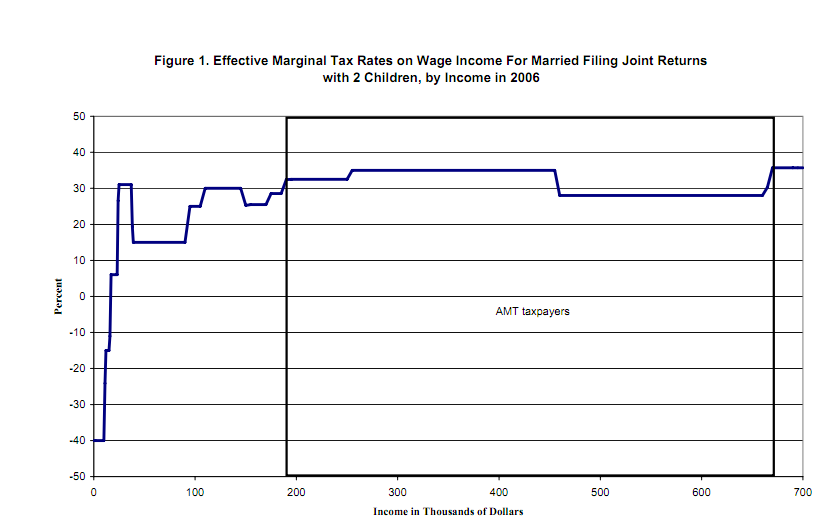
So we have now arrived at taxable income.  It is time to apply our marginal tax rate schedule to compute the amount of income tax.  The chart of marginal rates below comes from Jon Gruber's Public Finance and Public Policy, published a couple years ago, so the breakpoints are slightly different for 2011 returns, due to the automatic indexing for changes in the Consumer Price Index, but the graph below does give you the basic idea of how our tax code works.  The current rate schedule is available here, which shows that the key breakpoint for our MFJ taxpayers is $17,000.  That is, their first $17,000 of taxable income will be taxed at 10% and any income amounts beyond that will be taxed at 15%.  So, for example, a married couple with $20,000 in taxable income would pay 10%*(17000) +15%*(3000) = 1700 +450 = $2,150.  The important thing to realize is that once the couple enters a new bracket, only their incremental income over that threshold is subject to tax at the higher rate. Since our VITA site serves taxpayers with gross incomes up to $50,000, we do not expect to see any married taxpayers with federal statutory marginal brackets higher than 15%.   It is possible, however, that we will see a few single or MFS taxpayers in the 25% statutory bracket.


But, as they say on late night television, "Wait, there's more!"  We have not yet begun to apply credits.  Notice that my colored-coded 1040 has a hot pink highlighted section right below the income tax computation.  Those represent nonrefundable tax credits.  If our hypothetical married couple have a few kids under age 17, or if they paid for daycare in order to work, or if they put in new high efficiency home energy projects, those hot pink nonrefundable credits might wipe their tax bill all the way down to zero.  (But not lower than zero--that is why they are called nonrefundable.)

And--again--as they say on late night TV, "Wait, there's even more!"  The gold highlighted section at the very end represents the refundable credits.  Those can actually knock the taxpayer's liability into negative territory, so that the taxpayer could wind up with refund greater than the amount of withholding.

Don't try to absorb it all right now--just immerse yourself in thinking through this incredibly complex world.  There's lots to learn and absorb, and we'll also learn that there can be a big difference between the statutory marginal tax rate schedule sketched above and the actual effective marginal tax rate schedule shown below.

What is going on there, you may be asking yourself?  And what are the effects on incentives of such high marginal rates?  Tune in next week--after the VITA certification exam--and we'll talk more about it.

But take heart if this all seems like hopelessly confusing gobbledigook at the moment--and come to my helping hours tomorrow so you can work through practice examples which are similar to those on the exam--and to 95% of the situations that come up in practice at our VITA site.  You will be prepared before our class begins--with a bang! with the always challenging and bracing VITA certification exam on Wednesday.


Saturday, January 1, 2011

Sixth Commandment: Thou shalt not claim Head of Household status for thy taxpayer based on his unrelated roommate.

An unrelated deadbeat (or otherwise down on their luck) roommate who lived with the taxpayer all year can sometimes qualify as the taxpayer's "Qualifying Relative" (QR) dependent. (Check the rules in Table 2 here to be sure.) In that case, the taxpayer would be entitled to claim a dependent exemption for the deadbeat roommate and subtract the value of his $3,700 exemption from his taxable income.

However, unrelated roommates--even if they are QR dependents--are NEVER "Qualifying Persons" (QP) for the Head of Household (HoH) filing status!

HoH filing status requires that the taxpayer support a household containing a sufficiently related "QP". Unrelated roommates, girlfriends, boyfriends, or even distant relatives such as cousins are NOT QP's for HoH status, even though they might be QR's for dependent exemption purposes.

How "closely related" does a QP have to be for HoH status? Check the table on page B-3 here.

Once again, this illustrates that the IRS does not use English the same way the rest of us do. You don't necessarily have to be "related" by blood or marriage to be a "Qualifying Relative" dependent, but you DO have to be closely related by blood or marriage to be a "Qualifying Person" for HoH status.

Thursday, December 30, 2010

Fifth commandment: Thou shalt not let tuition tax benefits go unclaimed!


As this article in today's Times Union mentioned, a recent Treasury Department study suggests that tens of millions of dollars in tuition tax benefits went unclaimed last year.

Senator Schumer, the original sponsor of the American Opportunity Tax Credit, a tuition tax credit worth up to $2,500, came to town last week to raise awareness of the credit at a press conference held at Schenectady County Community College. Pictured above is Rachel Colman, a Union College senior interviewed by the Times Union, who told their reporter that she first learned about the tax credit when she interned for Senator Schumer last summer. She said her mother already knew about the credit thanks to her tax accountant, but not all families are fortunate enough to have tax advisors who are knowledgeable about the credit.

As Senator Schumer put it:

"The bad news is that far too many families don't know that this credit exists, but the good news is that it's not too late to put that cash in your pocket, even if you forgot to take the credit last year,"

"Too many middle-class families are not getting the benefit of this credit because they don't know about it, or their tax preparer failed to tell them about it," he said. "It's like there's a dump truck full of $100 bills sitting across the street."


Tax law is so confusing and labyrinthine and the rules are constantly changing--perhaps it is not surprising that many working families do not take advantage of the credits available to them. There are so many different tax benefits for education, and it can be hard for many families to figure out which one is best for them. There are also decisions to be made as to whether it is better for the child or the parent to take the tax credit. Even the National Taxpayer Advocate, Nina Olson, a tax lawyer and long-time former tax preparer herself, has said in the past that she has had difficulty figuring out which education tax benefit to use for her own college son.

In the past, many families had incomes too high or too low to benefit from tuition tax credits. The American Opportunity credit raised the income ceiling: married taxpayers making up to $160,000 may not realize they are now eligible for the full amount of the credit. In the past, the federal tuition tax credits were not refundable, which meant that they had little or no benefit for low-income taxpayers with no tax liability. The partial refundability of the current American Opportunity Credit means that even taxpayers with no federal income tax liability can benefit from it.

The American Opportunity tuition tax credit and other tax benefits for higher education are an important topic in Intermediate VITA tax law, so we will be tackling that next week, as soon as you finish the Basic tax certification exam.

For those of you who are already solid on Basic tax law, this is a good time to work through the VITA tutorial on Education tax credits, which you can find here. We will also discuss the late-breaking tax law change that extended the tuition tax and fees deduction, which may be a better deal than tuition tax credits in certain cases. An important concept to bear in mind: "the no double benefit" rule.

The IRS annual Pub 970, Tax Benefits for Education, is invaluable reading for parents and students alike. If your family discovers that you missed out on a tuition tax benefit to which you were entitled last year, it is not too late to file an amended tax return to claim it.

Fourth commandment: thou shalt enter each and every box of thy taxpayer's W-2 data faithfully and verbatim.


Fourth commandment: When thou usest tax software, thou shalt enter each and every box of thy taxpayer's W-2 data faithfully and verbatim.

There is a lot of important tax information embedded in a W-2, including some mysterious items that may not be obvious at first glance, so whenever you use tax software, you need to create a faithful verbatim electronic copy of the data in every box of the W-2.

If you do that meticulously, TaxWise should do the work of putting everything in the correct place on the Federal 1040 and NYS IT-201 tax forms, but it's important to understand WHAT you are doing and WHY you are doing it.

A few important observations:

0) "Verbatim" is a slight exaggeration: you are allowed--and encouraged!--to round dollar amounts to the nearest whole dollar.  Also, the IRS computers are apparently allergic to punctuation, so do not include it.  (E.g., if the taxpayer or employer's name has an apostrophe in it--like mine--leave it out.  Otherwise, as I learned the hard way a decade ago, you run the risk of giving the IRS computers a bad case of indigestion.)

1) Not all W-2s are laid out in exactly the same way. Some W-2s are vertical, some are horizontal, some are large, some are small. What is key is matching up the box numbers, box by box.

2) Be VERY careful to distinguish the words employEE from employER. A common source of problems is mixing up the employEE SSN with the employER tax ID number, or the employEE address with the employER address. (I'm capitalizing those letters distinctively for emphasis here, but the W-2 provides no such help.)

3) Those mysterious letters and codes in Boxes 12 through 14 give important information about contributory retirement plans (e.g., 401(k)'s) and other fringe benefit compensation that may have special tax treatment. As an example, let's consider Quincy Bennett's W-2 above from the IRS Pub 4491W workbook. (You can click on the image to see a larger and clearer view.)

Mr. Bennett's W-2 shows in Box 12a that he contributed $531 to his traditional 401(k) plan at Luther Petroleum. (How do I know that? The mysterious Code D in Box 12a. You can read more about what W-2 codes mean here.) That contribution reduced his wages subject to income tax in Box 1 by $531, but it did not affect his Box 3 and Box 5 wages for Social Security and Medicare payroll tax purposes. It also reduced his Box 16 wages subject to state income tax by $531.

4) The information in Box 2, federal withholding, and Box 17, state withholding, is especially important! It is literally "money in the bank," because it represents money that the employer has withheld from the employee's pay that needs to be credited against his federal and state tax liability. If you accidentally omit that data input (it's especially easy to overlook the Box 17 information), you can literally give your poor taxpayer a heart attack by wrongly telling him he owes a lot of money, when in fact, he actually owes much less or may even be entitled to a refund.

5) UPDATE:  The Advance EIC is no longer an option.  It was eliminated 10 years ago.  Few taxpayers chose it (for reasons we will discuss in class) and it created more trouble than it was worth for some of those who did. A frequently overlooked item: "Advance EIC payment" in Box 9. For example, see Ms. Colby Bennett's W-2 below. (Again, click on the image for a clearer view.) There is $1,200 in Box 9. That tells me that me that--at her request, her employer, the William School District, included $1,200 of Advance Earned Income Credit (EIC) payments in her paychecks during the year. Effectively, her employer gave her an advance on part of her refund, and that advance needs to be subtracted from the refund she will get at the end of the year. If you enter the Box 9 information into the electronic W-2 in TaxWise, you should check to make sure that TaxWise puts that number into line 59 on the 1040.


In effect, "Advance EIC" is a form of negative withholding. This complication rarely happens in real life--only about 1% of EIC recipients choose to collect some of it in advance, but when it does happen, it is essential to take it into account! It comes up far more frequently in IRS workbook exercises (and maybe the the certification exam!) than in real life. In the interests of tax simplification, the provision for Advance EIC is ending with the 2010 tax year, so this should be the last year we need to worry about this.

Tuesday, December 28, 2010

Rock-Paper-Scissors rules for tax law

Okay--I'm out of hard-and-fast commandments for now, so I'll move on to another analogy: tax law can sometimes be like rock-paper-scissors.

1) When considering dependent status, Qualifying Child (QC) trumps Qualifying Relative (QR). In other words, if the potential dependent is anyone's QC, he can't qualify as a QR for anybody. Do not ever check for QR status without first ruling out the possibility that the potential dependent could be a QC for that taxpayer or for another taxpayer.

2) When considering QC status, relationship and residence trump support. In other words, if the potential dependent is a QC of more than one taxpayer, it does not matter which taxpayer provided more support. The tiebreak rules for QC give priority to relationship and residence. Remember that you don't need to support a QC to claim him! The support test for a QC exemption just requires that the QC does not provide more than 50% of his own support.

3) After ruling out QC status, then--and only then--can you consider the possibility of QR status, in which case support may possibly trump relationship and/or residence. You do need to support a QR to claim him or her, but you may not need to live with him (depending on how closely he is related to you.)

It is complicated! I've read Tax Court cases that make it clear that even IRS auditors have occasionally incorrectly applied the rules. That is why it is important to carefully work through the flowcharts in Tab C of Pub 4012 when determining QC and QR dependents.

For more on that topic, see here.

Third Commandment: All thy income is taxable ... unless tax law explicitly states it can be excluded.

Commandment #3: Thou shalt report all thy income on thy 1040 unless there is an explicit provision in tax law allowing thee to exclude it from thy tax base.

The general rule: all income is subject to income tax unless there is a provision in tax law explicitly excluding it from taxation.

Do not leave income off a taxpayer's return unless you can find an explicit provision allowing you to do so. Even there--be careful!

For example, even though gifts are excludable from taxable income, not everything called a "gift" is actually a "gift" for tax purposes. If your taxpayer's grandma gave him a gift, it's different from his employer giving him a gift. If in doubt, check with your professor!

And remember, "income" does not have to be in cash to be "income." That year's supply of dog food you won on a game show is income! So is that "designer purse" you won at a charity raffle. Or the Xbox you won in the Microsoft College Puzzle Challenge. So is the bike your employer gave you if you worked at Ikea. (See here for more on that.) Even a scholarship that provided free room or board is income. (See here for more on that.)

For more information on common types of taxable and non-taxable income, see here.

Second Commandment: thou shalt live for over half the tax year with thy EIC Qualifying Child

Commandment #2: Thou shalt live with thy Qualifying Child for over half the tax year in order to claim thy Qualifying Child for Earned Income Credit purposes.

In modern English: although there are special circumstances in which divorced or separated parents can claim a QC for other tax benefits, the Residence Requirement is an absolute requirement for Earned Income Credit (EIC).

A non-custodial parent with whom the child lived less than half the year NEVER, EVER, EVER gets to claim the QC for EIC purposes!

It doesn't matter if the custodial parent wants to give the EIC away to the non-custodial parent. If the noncustodial parent taxpayer did not live with the kid, the taxpayer is not allowed to claim the kid for EIC purposes!

Ya can't claim the kid for EIC without living with the kid!

Interestingly, you don't need to support your QC to claim him for EIC purposes, but you do need to live with him!

Residence is the sine qua non requirement for EIC QC purposes.

That is really important, because the EIC is by far the largest tax benefit associated with children in low-income working families. As you can see from the graph below, whether a taxpayer has children can make a huge difference in their EIC refund, so it's critically important to get this detail correct, so the EIC goes to the taxpayer actually entitled to claim the QC for EIC purposes.


(Caveat: remember that the IRS does not define "live with" quite the same way as normal people do. If the child was born or died during the year or had temporary absences for college, medical reasons, etc. the IRS may deem that s/he "lived with" the taxpayer for all 12 months of the year for tax purposes.)

For more information about EIC rules, see here.

First Commandment: Dependents shalt claim no dependents

Commandment #1: Thou shalt have zero exemptions on thy own tax return if thou meetest the qualifications to be a dependent of another taxpayer.

In modern English: if you qualify to be claimed as the dependent of another taxpayer, you may NOT claim a personal exemption for yourself, nor may you claim any dependents of your own on your tax return.

No ifs, ands, or buts: as long as the other taxpayer(s) COULD have claimed you on their tax return, it does not matter whether they actually DID claim you on their tax return--you may not claim yourself on your return nor may you claim any dependents on your return.

For more information about rules for personal and dependent exemptions, see here.

There are some other negatives for taxpayers who can be claimed as dependents. In particular, if you can be claimed as a dependent by another taxpayer, you are NOT eligible for the Making Work Pay refundable tax credit.

This led to some unpleasant surprises for young dependent taxpayers last year. Some of them ended up owing money, when they had been expecting at least a small refund. That's because payroll withholding formulas did not take into account their dependent status, so they had not had enough federal tax withheld from their pay.

Ten (?) Commandments of Basic Tax Law

My Union College Volunteer Income Tax Assistance (VITA) students are now studying hard for their upcoming IRS Certification Test in Basic tax law, which I'll give on the first day of class, next Monday.

I have annotated and highlighted the key sections of the so-called "bible" of VITA, Pub 4012, the handy reference tool with flow-charts going through the logic of all the bed buffaloes in the tax law applicable to tax returns that are "within the scope of certification" for VITA sites.

You can find my training resource website for students by clicking here.

But there is quite a maze of intersecting logical questions in determining the answers to many tax questions, so I thought I would try to help my students out by coming up with a few hard-and-fast absolute rules--I will call them the "Commandments of Tax Law."

I am not sure if there will be exactly ten of them, but I'll get started with a few and I'm open to suggestions in the comments for more.

The key to being a commandment is that it needs to be a universally true and simple tax rule that has wide applicability in basic tax law.

Stay tuned for the first few.